Updated: 2026-06-09 · Author: Michael Torres, iGaming Industry Analyst & Independent Consultant
What it really takes to launch an online casino
Launching an online casino in 2026 is a regulated B2C business with a global addressable market valued at USD 78.66 billion in 2024 and projected to reach USD 153.57 billion by 2030 at an 11.9% CAGR. The opportunity is real, the entry bar is high, and a meaningful share of new ventures fail to reach sustainable unit economics within 18 to 24 months because licensing, platform and compliance choices were made out of sequence. The Online Casino Business is a single legal entity built on three interdependent dependencies: a Gambling License that defines which players the brand can legally accept, an Online Casino Platform that runs day-to-day operations, and Regulatory Compliance (KYC, AML, responsible gambling) that determines whether banks and game providers will engage at all.
This guide is written for founders, GMs and investors evaluating a 2026 launch. Every number is sourced or marked as a market range, every licensing fee is the figure published by the regulator, not the marketing brochure. The aim is to give the reader the same operational picture I would brief a private client through, with no upsell and no soft-pedaling of risk.
Key Takeaways
- Realistic minimum capital before the first player deposit: $300,000 to $500,000, with licensing, platform, payments, compliance and 6 months of operating runway included.
- Licensing decides everything downstream. MGA application is €5,000 plus €25,000 annual and €15K-€375K compliance contribution; Curaçao under the 2026 LOK regime runs roughly $5K application plus ~$15K annual base, with first-year all-in around €60K including local substance.
- Software model is a phase-one decision. White label launches in 4-12 weeks at $15K-$35K entry; turnkey runs 3-6 months at $50K+; custom builds need $500K-$2M+ and 12-24 months.
- Crypto Casino is a structural growth lane, not a sub-niche. Younger demographics, faster payouts and provably-fair mechanics now define a sizeable share of new launches.
- Marketing is the survival line. CPA in regulated EU markets runs $100 to $500+ per depositing player; affiliate and SEO must be live before launch day, not after.
- Responsible gambling is a competitive moat. Operators who build deposit limits, self-exclusion and GAMSTOP integration before marketing begins face fewer regulatory actions and lower chargebacks.
Understanding the online casino market before building
Market research is Step 1, not Step 3. The order matters because licensing strategy, platform choice and acquisition channels all flow from where the operator intends to take real money from real players. Skipping this layer is the single most reliable predictor of an unsellable business 24 months later. The four sub-sections below cover global market sizing, competitor mapping, niche selection and a weighted decision framework for picking a launch market.
Global iGaming market size and growth trends
The global online gambling market is on a verified growth curve, with Grand View Research estimating USD 78.66 billion in 2024 and USD 153.57 billion by 2030 at an 11.9% CAGR. Europe led with over 41% of 2024 share. Latin America (Brazil’s 2025 regulated market launch), parts of Africa and Asia-Pacific are the genuine greenfields; the EU is saturated but still high-value. Three macro tailwinds keep showing up in every sourced trend report: smartphone penetration in emerging markets, crypto adoption among under-35 players, and regulatory liberalisation in jurisdictions that previously banned online gambling. The Crypto Casino segment is a growth driver inside the broader Online Casino Business curve, not a niche aside.
Identifying real competitors and understanding their strengths
A useful competitive map covers five direct competitors in the target market and five aspirational competitors one tier up. SWOT each on brand trust, content depth, payment flexibility, support quality and bonus economics, then identify one realistic dimension on which a new operator can differentiate. Tier-1 references like Bet365 and DraftKings set the customer-experience ceiling. The Marketing Strategies entity matters here because new operators tend to copy tier-1 acquisition tactics without the brand equity to make them work. Players’ core needs stay constant: security, game variety, fast payouts and competent support. Pick one and own it.
Choosing a niche: slots-heavy, live dealer, sports betting hybrid, or crypto casino
Niche is a downstream-cost decision, not a brand preference. A slots-heavy platform has lower operational complexity, high volume and a logical fit with white-label content aggregators; live dealer casinos command premium session durations but demand higher infrastructure and pricier studio contracts; crypto casinos attract a privacy-focused, loyalty-inclined base and accept Bitcoin, Ethereum and stablecoins; hybrid sportsbook-and-casino platforms carry the highest complexity and the highest revenue ceiling.
- Slots-heavy fits first-time operators using a white-label aggregator; lowest content cost; widest game provider choice.
- Live dealer-led suits boutique brands; Evolution-driven studio costs run higher per stream.
- Crypto casino appeals to a loyalty-inclined audience; Bitcoin casino players show measurably higher repeat-deposit rates than fiat-only cohorts.
- Hybrid casino plus sportsbook carries the biggest tech stack and the biggest ceiling; needs sportsbook licensing and trading expertise.
For most first-time operators, a slots-focused white-label with crypto layered on as a phase-two payment option is the lowest-risk entry path.
How to choose the optimal launch market: a practical decision framework
The market scoring formula I use with private clients: Market Score = (Market Potential x 0.30) + (Regulatory Friendliness x 0.25) + (Tax Efficiency x 0.20) + (Competition Level x 0.15) + (Payment Infrastructure x 0.10). Score each factor 1-10, then compare candidates side by side. A worked example: Germany scores high on market potential but is heavily taxed (5.3% turnover tax on slots) and crowded; Brazil scores high on potential and infrastructure post-2025 regulation but has aggressive new entrants. Markets like New Jersey illustrate the US state-by-state reality, where regulatory clarity is high but each state is a separate license application.
- Market Potential (30%): GGR pool, projected growth, smartphone penetration
- Regulatory Friendliness (25%): licence accessibility, sub-licensing rules, payment channels
- Tax Efficiency (20%): gaming duty, corporate tax, treaty network
- Competition Level (15%): number of licensed operators, top-3 GGR concentration
- Payment Infrastructure (10%): local APMs, card acceptance, crypto tolerance
Regulatory clarity trumps raw market size every time. A bigger market with murky rules will eat the working capital that should have funded acquisition.
Legal foundations: how to obtain an online casino license
Licensing is the single most consequential decision in the entire launch process. It determines where the brand can legally accept players, which payment processors will engage, which game providers will integrate, what the annual compliance bill looks like, and ultimately whether the business is a sellable asset or a contract on someone else’s master license. Operating without a license before the first deposit is a fast route to banking blacklists, criminal exposure in some jurisdictions, and a brand that no payment processor will touch. The Malta Gaming Authority and Curaçao Gaming Control Board are the two anchor reference jurisdictions for the comparison work below.
Why licensing is the most important decision in the launch process
A gambling license has two functions: legal permission to operate, and a commercial trust signal that unlocks B2B access to tier-1 game studios, banks and payment processors. Visa, Mastercard and major e-wallets like PayPal will not process payments for unlicensed gambling operators; tier-1 studios like Pragmatic Play and Evolution will not integrate without licence verification. The cautionary case is consistent across the industry: operators who launch in a gray jurisdiction without a license are typically blacklisted by every major card network within 60 days of going live, lose their domain provider, and watch their affiliate revenue dry up because affiliates refuse to send traffic to brands that can’t pay reliably.
Top gambling jurisdictions compared: MGA, Curaçao, Isle of Man, Gibraltar, UKGC, and more
The 2026 jurisdictional landscape has bifurcated. Top-tier regulated markets (MGA, UKGC, Gibraltar, Isle of Man) command premium player trust and higher entry costs. Entry-tier jurisdictions (Curaçao under the 2026 LOK regime, Anjouan, Tobique) keep the door open for first-time operators and crypto-first launches, with the trade-off being narrower payment-processor acceptance. Kahnawake remains relevant for North American-facing Indigenous-licensed operations. Watch markets: Finland’s planned liberalisation by 2027-2028, UAE’s new iGaming regulator, and New Zealand’s 2025 framework review. EU-targeting operators carry GDPR data-residency obligations on top of the gambling license.
| Jurisdiction | Application fee | Timeline | Player markets accessible | Reputation | Best for |
|---|---|---|---|---|---|
| Curaçao (CGA / LOK) | ~$5,000 + ~$15,000 annual base; ~€60K Y1 incl. local substance | 8 to 16 weeks | LatAm, Asia, crypto-tolerant gray markets | Entry-level | Fast launches, crypto-first |
| Anjouan (Comoros) | $5,000 to $10,000 + $10K-$25K annual | 4 to 8 weeks | Emerging markets, crypto | Entry-level | Cost-led launches |
| Kahnawake (Canada) | $25,000 + $10K annual | 8 to 12 weeks | North America (limited) | Mid-tier | Indigenous-licensed brands |
| Isle of Man (GSC) | $5K-$50K + $35K-$75K annual | 8 to 16 weeks | EU, regulated Asia | Mid-tier | Mid-credibility launches |
| Malta (MGA) | €5,000 application + €25,000 annual; €15K-€375K compliance contribution | 4 to 6 months | EU passporting, LatAm, parts of Africa | Top-tier | Regulated EU operators |
| Gibraltar (GRA) | £30,000 application; £100K duty cap | 3 to 6 months | UK, EU regulated | Top-tier | Mid-large operators |
| UK (UKGC) | £5,000 to £80,000+ scaled to GGY | 6 to 16 months | UK only | Top-tier | UK-focused operators with compliance bench |
| Tobique (Canada) | $20K-$30K + annual | 6 to 12 weeks | LatAm, crypto markets | Entry-level | Sportsbook-first launches |
Structuring an online casino business entity: three approaches compared
Three structuring paths cover virtually every 2026 launch. Each has a different control, cost and timeline profile, and each interacts differently with the operator’s long-term exit valuation.
-
Register a new company and apply for a license directly. Maximum control, 6 to 18 months end to end, highest upfront cost ($150K+ depending on jurisdiction). The business is a sellable asset with the license in its name. Best for operators with capital, compliance bench and a multi-year horizon.
-
Purchase a pre-licensed or shelf company. Faster entry, typically 30 to 90 days, but requires legal due diligence on the target’s compliance history, AML/KYC liabilities and outstanding regulator correspondence. Many first-time operators underestimate the inherited liability risk; a clean shelf company with a real licence is rare and priced accordingly.
-
Launch via white label under an existing licensee’s umbrella. Fastest at 4 to 8 weeks, lowest upfront cost, but a 15-50% revenue share, limited brand independence and the operator does not directly hold the licence. The White Label Solution path is covered in depth in White Label vs Turnkey Casino and White Label Casino Cost; both spell out the trade-offs. Critically, Curaçao’s 2026 LOK reform eliminated the sub-license model in that jurisdiction, so the sub-license route is on a managed runoff for serious operators.
KYC and AML obligations apply to all three structures; the structure determines who is the named license holder, not whether identity verification and transaction monitoring are required.
The license application process: timeline, documentation, and common pitfalls
Roughly 70% of license application delays I see in private practice trace back to incomplete or inconsistent AML/KYC documentation, not technical failures. A regulatory consultant who has filed in the target jurisdiction will typically save three to six months and $30K-$80K in rework on a first application. The process below is the standard MGA, Curaçao or UKGC sequence; specifics vary, the order does not.
- Form the legal entity in the licensing jurisdiction (or in a permitted shareholder structure).
- Disclose beneficial ownership and source-of-funds documentation for every shareholder above the regulator’s threshold.
- Submit AML, KYC, responsible gambling and data-protection policy documents.
- File three years of audited financial statements (or founders’ equivalents).
- Submit RNG certification from an accredited lab (eCOGRA, iTechLabs, BMM Testlabs).
- Provide PCI DSS evidence for payment processing.
- Pay application fees and demonstrate working capital sufficient for player-fund protection.
- Complete the regulator’s fit-and-proper interview and background checks.
- Pass the operational readiness inspection (test environment, support flow, RG tools live).
- Receive the licence; begin operations.
MGA timelines run 4-6 months in clean cases. Curaçao under LOK runs 8-16 weeks. Isle of Man typically lands at 3-6 months. UKGC remains the slowest at 6-16 months and the most documentation-heavy.
Ongoing compliance obligations after obtaining a license
Licensing is a recurring operational cost, not a one-time event. Annual fees, license renewal, responsible gambling reporting, player-fund segregation, independent audits, KYC and AML monitoring, game re-certification, and GDPR data protection compliance all run continuously. Major payment processors (Visa, Mastercard, Worldpay, Skrill) conduct independent compliance checks on top of the licence, so a regulator-issued certificate does not automatically unlock processing relationships. Build a compliance calendar from day one with renewal dates, audit windows and reporting cadences locked in. Independent audit bodies like eCOGRA and iTechLabs are not optional in most tier-1 jurisdictions. Treat the compliance function as a competitive moat: operators with mature compliance get better PSP rates, easier banking and fewer surprise interventions.
Building a business model and financial plan
Financial modelling is not optional; it is the exercise that determines whether this venture is viable before a single dollar is spent on software or licensing. The operators who fail almost universally modelled around best-case acquisition scenarios, then ran out of working capital in months 4 through 9 when reality undershot the plan. Model the worst case, fund the worst case, and build a P&L Statement structure from day one that tracks GGR, NGR, marketing spend, rolling reserves and compliance cost as separate line items.
How online casinos generate revenue: revenue models explained
Casino revenue comes from the house edge built into game math, set by Game Providers at the studio level, not by the operator. A typical slot game has a 96% RTP, leaving a 4% house edge as the operator’s gross margin on bets. Other revenue streams include rake on poker rooms, sportsbook margin (typically 4-8% on regulated markets) and platform fees for white-label sub-tenants. Two metrics matter from day one: Gross Gaming Revenue (GGR), which is bets minus payouts, and Net Gaming Revenue (NGR), which subtracts bonuses, taxes and chargebacks. Bonus cost is usually the largest single P&L leakage in the first 12 months; an over-generous welcome offer that’s not properly capped will turn a positive-margin month into a loss before the operator notices.
The real cost of launching an online casino
Minimum committed capital before the first player deposit is $300,000 to $500,000 for a competitive 2026 launch. That figure assumes a credible mid-tier license (Isle of Man, Anjouan or MGA Y1 partial), a white-label or turnkey platform, payment processing setup, compliance tooling, a small team and 6 months of operating runway. Anything below this number works only if the operator brings existing affiliate traffic or a previously-built CRM list. Detailed cost line items by category, including ongoing GGR rev-share economics and three budget tiers, are broken out in White Label Casino Cost.
Pre-launch expenses:
- Licensing: $15,000 to $150,000+ depending on jurisdiction
- White-label or turnkey platform setup: $5,000 to $100,000
- Custom front-end design: $5,000 to $40,000
- Payment processing setup and reserves: $5,000 to $20,000+ in float
- Legal and consultant fees: $20,000 to $80,000
- KYC, AML and compliance tools: $1,500 to $15,000
- Initial team payroll and recruiting: $30,000 to $100,000
- Pre-launch marketing and PR: $20,000 to $100,000
Post-launch Year 1 expenses:
- Ongoing marketing and player acquisition: $100,000 to $1,000,000+
- Staff salaries (5-10 FTE plus outsourced support): $250,000 to $750,000
- Platform monthly fees or rev-share: $24,000 to $400,000+ depending on model and GGR
- License renewals and compliance contributions: $25,000 to $400,000+
- Game provider royalties and surcharges: 2-10% of GGR per premium provider
- Software maintenance, hosting, CDN, DDoS protection: $12,000 to $60,000
Player lifetime value, acquisition costs, and break-even projections
The single most important KPI is the LTV:CPA ratio, not gross player count. iGaming CPA via affiliates runs $150 to $500+ per first-time depositing player in 2026, with the upper bound in UKGC, Ontario and German regulated markets. Welcome bonus cost should be modelled separately because it inflates CAC on paper. Realistic Year 1 marketing allocation for a new launch is over 50% of operational spend; under-investing here is a guaranteed path to a thin player base that can’t reach break-even. Affiliate Marketing is the channel most likely to drive early CPA efficiency because affiliates carry the upfront acquisition cost. Time to profitability for a competently-launched mid-tier casino typically runs 9 to 18 months from go-live, assuming retention KPIs hit industry norms.
Building the core team: who is needed to launch and operate
The biggest mistake new casino operators make is treating the launch as a solo project. An online casino is cross-functional from day one. The core team I recommend for a credible mid-tier launch covers eight roles, with some outsourceable to specialist B2B providers in early stages. Larger white-label and turnkey vendors, including SoftSwiss, SoftGamings and PWP (PlayWinPlay) ★, include managed services (support, anti-fraud, RG monitoring) as part of the platform package. Evaluate managed services as part of total cost of ownership, not as a hidden extra.
- General Manager. Owns P&L, vendor relationships, and the launch roadmap.
- Compliance and Legal Officer. Runs KYC, AML, RG reporting and regulator correspondence; directly tied to the Best White Label Casino Software Providers vendor evaluation work.
- Marketing Manager. Paid acquisition, affiliate management, brand campaigns.
- Head of VIP and Retention. Top 5% of players typically generate 50%+ of GGR.
- Customer Support Team. Live chat, email, dispute resolution; 24/7 cover required in most jurisdictions.
- Anti-Fraud Analyst. Chargeback monitoring, bonus abuse, multi-account detection.
- Content Manager. Site CMS, promotional landing pages, blog and SEO content.
- Finance and Payments Manager. Daily cash position, PSP reconciliation, rolling-reserve tracking.
Choosing the right casino software platform
The software decision flows logically from the financial plan, not the other way around. Operators who have done the budget and team work in the previous sections will pick a better-fit platform than those who shop on feature lists. Software is typically the second-biggest upfront commitment after licensing, and it determines what the player-facing product can actually do. The three model choices below are covered in depth in White Label vs Turnkey Casino; this section is the operator-launch framing.
White-label vs. turnkey vs. custom-built casino software: which is the right choice
There is no universally best model; there is a best-fit model for the operator’s capital, team and three-year horizon. White-label is the fastest path to market and the highest long-term cost; custom-built is the most expensive entry and the lowest long-term cost; turnkey sits in between. The break-even crossover analysis between white-label rev-share and custom-build amortisation typically lands around €200,000 annual GGR for entry budgets, with the gap widening sharply above that.
- White Label Solution. 4 to 8 weeks to launch; setup $5K-$30K; 15-50% of NGR rev-share; minimal customisation; ideal for first-time operators testing the market or running a single-vertical brand.
- Turnkey Solution. 3 to 6 months to launch; setup $30K-$100K; operator brings own licence; moderate customisation; fits already-licensed mid-scale operators with a compliance bench.
- Self-Service (Custom) Solution. 12 to 24 months; $500K-$2M+ initial build; operator owns the stack; full customisation; appropriate for operators with a clear 3-5 year vision and engineering capacity.
Treat the white-label model as a phase-one launch vehicle with a documented migration trigger (e.g., at €200K monthly GGR, evaluate transition), not a permanent home.
Leading casino software providers worth evaluating
The market splits into a small group of mature, multi-licensed platforms and a much larger field of niche or regional vendors. Of the 16 platforms covered in our independent ranking, six are the most frequently shortlisted by new operators: SoftSwiss (40,000+ games, crypto-native since 2013, MGA + Curaçao + Estonia), EveryMatrix (CasinoEngine + OddsMatrix, MGA B2B + UKGC software, multi-brand enterprise), Digitain (sportsbook-first, MGA B2B + UKGC, omni-channel), BetConstruct (12 regulators including MGA and UKGC, single-stack casino plus sportsbook), Slotegrator (Anjouan B2B + Curaçao, APIgrator with 30,000+ titles), and PWP (PlayWinPlay) ★ Editor’s Choice (fastest launch at 2-4 weeks, 15,000+ games across 160 studios, crypto-ready, bundled active licence). Evolution Gaming is the de facto standard for live dealer integration regardless of which platform vendor is chosen. Due diligence essentials, in priority order: uptime SLA in writing, named markets already certified, named live operating references, and the contractual answer to “who owns the player database at termination”. Demo every vendor, talk to at least two live operators on each shortlist before signing.
Essential platform features required before launch
The platform must ship with a non-negotiable feature set before the first marketing dollar is spent. RNG certification by eCOGRA, iTechLabs or BMM is required by virtually all tier-1 regulators and independently verified by payment processors. The checklist below is the operator-side acceptance test, not a vendor wish list.
- Certified RNG with current eCOGRA, iTechLabs or BMM testing
- Real-time reporting dashboard for GGR, NGR, CAC and DAU
- CMS for promotional pages, T&C updates and content workflow
- PAM (Player Account Management) system with full lifecycle
- Multi-currency and multi-language support
- CRM with segmentation, automated campaigns and player notes
- Bonus engine with wagering, cap and exclusion logic
- Responsible gambling tools (deposit, loss, session limits; self-exclusion)
- Affiliate management software with tracking pixels and postbacks
- Anti-fraud module: device fingerprinting, velocity checks, geolocation
- Mobile-responsive design and tested PWA or native app
- API flexibility for third-party game, payment and KYC integrations
- KYC and AML integration with automated document verification
- PCI DSS compliance for any card data handling
- Geolocation blocking for excluded markets
Curating a winning game library
The game library is the casino’s product shelf and the most visible output of every licensing, software and infrastructure decision made earlier. Depth, quality and curation directly determine session duration, average bet size and 60-day repeat-deposit rate. Game library decisions must connect back to the niche strategy from the market analysis section: a slots-led platform and a live dealer boutique need fundamentally different mix ratios, even if both use the same aggregator.
How to select the right game providers for a casino platform
The content industry has three layers: tier-1 studios, game aggregators that bundle hundreds of studios into a single integration, and niche specialists. Tier-1 studios in 2026 remain Pragmatic Play, NetEnt, Play’n GO, Microgaming and Evolution (live dealer). For first-time operators, a game aggregator is typically the right entry choice; a single integration unlocks hundreds of games at fixed terms instead of negotiating studio contracts one by one. Due diligence per studio or aggregator covers RTP and volatility ranges, mobile optimisation, regulatory certifications in target markets, and rev-share or fixed-fee economics. Curation excellence beats comprehensiveness; 600 well-merchandised games convert better than 6,000 dumped into a generic lobby.
Must-have game categories: slots, table games, live dealer, and emerging formats
Slots typically occupy 60-70% of game libraries and generate 80%+ of GGR in most operator P&Ls. Table games (blackjack, roulette, baccarat) anchor session variety and serve high-value players. Live dealer content (Evolution Gaming’s Crazy Time, Lightning Roulette and Monopoly Live in particular) has shifted from novelty to core retention infrastructure across mid-tier and premium brands. Emerging formats include crash games (Aviator dominates), game shows, and virtual sports. Provably-fair crypto games appeal disproportionately to under-35 players; the Crypto Casino segment uses provable fairness as a trust signal that fiat casinos do not have access to.
Jackpots and jackpot aggregators as a player retention engine
Jackpot mechanics increase player LTV, raise average bet size and pull lapsed players back into active play. Two implementation paths dominate. Casino-integrated jackpot modules (built into the platform vendor’s stack) are the most seamless; standalone jackpot aggregators offer cross-brand pools at the cost of an additional integration. The business case is consistently strong:
- Higher player LTV through extended session lifetimes
- Higher average bet amount as players chase progressive prizes
- New player acquisition via “$X million prize” creative
- Lapsed-player reactivation through jackpot trigger emails
- Direct GGR uplift on jackpot-eligible games
- Premium-segment retention via physical-prize jackpots (cars, travel)
- VIP marketing lever for high-roller segments
- Cross-sell between casino verticals (slots to live to crash)
Loyalty-point and physical-prize jackpots run alongside cash jackpots in mature operator programs; they tend to outperform cash for premium segments because they are harder to compare against competitor offers.
Setting up secure and reliable payment systems
Payments are the operational backbone players touch the most, not a feature buried in the back office. A perfectly designed casino will hemorrhage signups at the deposit step if the payment experience is slow, narrow, or fails for a player’s preferred method. Banks and acquirers classify gambling operators as high-risk by default, which complicates the entire payment stack relative to almost any other industry. The three sub-sections below cover the high-risk reality, the optimal payment mix, and the KYC and AML infrastructure that sits underneath.
Why payment processing is more difficult in iGaming than in other industries
High-risk merchant classification adds 1 to 3 percentage points to standard processing fees, imposes rolling reserves of 5 to 15% of volume for 90 to 180 days, and limits which acquirers will engage at all. Visa and Mastercard both maintain restrictive gambling-merchant policies that filter out unlicensed and underbanked operators on principle. Rolling reserves are the most consistently under-modelled line item I see in new operator pro formas: at $100K monthly GGR with a 10% reserve held 180 days, the PSP sits on $60K of working capital after six months. Build multiple PSP relationships from day one to avoid single-vendor concentration risk, and treat PCI DSS as a baseline, not an upgrade. Crypto payments sidestep some of the card-network friction at the cost of regulatory and AML scrutiny in their own right.
Fiat, crypto, and e-wallet integration: building a payment mix players trust
Adding a player’s preferred payment method to the deposit page increases deposit conversion by 15 to 30%, making payment diversity a revenue lever and not just a convenience feature. A credible 2026 payment mix combines four layers: cards (Visa, Mastercard), e-wallets (Skrill, Neteller, PayPal where licensing permits), bank transfers including local APMs (Pix in Brazil, Zimpler in Scandinavia, AstroPay in LatAm, UnionPay for China), and cryptocurrency (Bitcoin, Ethereum, USDT). Crypto licensing nuances vary by jurisdiction and should be confirmed with a licensing attorney before committing to a crypto-first or crypto-supplementary model. Machine-learning fraud detection and 3D Secure 2 are now baseline expectations from both PSPs and regulators, not optional add-ons. Traditional Fiat Casino brands gain by adding 1-2 well-chosen local APMs per market; the conversion lift typically justifies the integration cost inside the first quarter.
KYC, AML, and fraud prevention: the compliance infrastructure required
KYC and AML are mandatory across virtually every regulated jurisdiction and increasingly demanded directly by payment processors regardless of licence. Automated KYC is a revenue optimisation decision, not just a compliance one: industry-leading verification providers Jumio, Onfido and Sumsub typically convert verifications 30-50% faster than manual review at scale, with per-verification fees of $1 to $3 and platform fees of $500 to $5,000 monthly. ComplyAdvantage is the most commonly used AML transaction-monitoring vendor in the mid-market. Anti-fraud modules covering device fingerprinting, velocity checks, geolocation verification and behavioural ML are core platform requirements, not optional. The under-stated commercial benefit of mature KYC: chargeback rates drop sharply, which directly compresses one of the largest P&L leakage lines for new casinos.
Designing a casino website and player experience that converts
Casino website design is a revenue exercise, not an aesthetic one. Even a perfectly licensed, well-stocked casino will fail at the deposit step if its site is slow, confusing or visibly untrustworthy. The four sub-sections below cover UX, mobile-first design, conversion optimisation and the technical floor required for licensing and PSP acceptance.
UX design principles specific to casino platforms
Top-performing casinos surface their most popular games within two clicks of homepage landing. Every additional click reduces session depth measurably. The UX checklist for a credible launch covers game lobby filtering and search, trust-signal placement (licence logo, security badges, payment method strip) above the fold, a streamlined registration flow with progressive disclosure of KYC fields, and a visual identity distinctive enough to be remembered by players visiting comparison sites before they deposit. Brand identity matters more in iGaming than in most B2C verticals because players almost always evaluate two to four brands before picking one.
Mobile-first design: a non-negotiable standard for modern casino operations
Mobile traffic now represents 60 to 75% of online casino sessions globally and over 80% in Africa, Southeast Asia and Latin America. Mobile-first design is not an upgrade path; it is the launch standard. Build for low-end Android devices as the baseline, not flagship iPhones; a meaningful share of the global gambling audience uses mid-range hardware with constrained data plans. Mobile game load speed under 3 seconds, thumb-friendly navigation, and a deposit flow optimised for autofill and 3DS are the operator-side acceptance criteria for go-live.
Speed, security, and uptime: technical standards that must be met
The technical floor for a 2026 launch: page loads under 2 seconds, full SSL, DDoS protection via Cloudflare or AWS Shield, 99.9%+ uptime SLA from the platform vendor, and a global CDN. GDPR-bound operators must store EU player data within EU borders, which constrains hosting choices. Inadequate DDoS protection on launch day is one of the most concrete failure modes in the industry; a targeted attack during the first week of marketing can compromise player trust and licensing standing simultaneously. A global CDN is one of the most cost-effective infrastructure investments available, often improving conversion in remote markets more than any UX change.
Responsible gambling: building a framework that protects players and the license
Responsible gambling is simultaneously the right thing to do for players and the commercially prudent thing to do for a sustainable business. It is a licence requirement at MGA, UKGC and Ontario; it is a payment-processor requirement at most tier-1 acquirers; and it is increasingly an expectation among the very player segments operators most want to retain. Operators who build the framework in before launch face fewer regulator interventions, lower chargeback rates and stronger long-term brand equity. Regulators routinely fine non-compliant operators in the seven and eight figures.
Responsible gambling tools that must be implemented before launch
Every tool below must be live before any marketing campaign goes out, not after. Regulators audit RG tooling first when a complaint is investigated; missing or non-functional controls produce regulatory findings with multi-million dollar fine exposure.
- Deposit limits (daily, weekly, monthly) with hard caps the player sets
- Loss limits and net deposit caps
- Session time limits and reality checks
- Cooling-off periods (24 hours, 7 days, 30 days)
- Self-exclusion at the operator level
- National self-exclusion scheme integration (GAMSTOP in the UK; equivalents in MGA, ON)
- Access to support resources (Gamblers Anonymous, BeGambleAware, GAMCARE)
- Affordability and source-of-funds checks for high-stakes players
- Activity statements available on demand
- Operator-side player risk flagging with mandatory escalation paths
Responsible gambling as a brand differentiator, not just a compliance requirement
Players who trust a casino with their wellbeing show measurably higher long-term LTV than players acquired into a pure-extraction model. Retention is cheaper than acquisition by a factor of five to ten, depending on market. The strongest long-term casino brands invest in responsible gambling proactively because it lowers acquisition pressure, improves review-site scores, and reduces churn from the segments worth keeping. Frame RG investment as a product feature, not a compliance line.
Casino marketing and player acquisition strategy
Marketing is not the last step in launching a casino. It is a parallel workstream that begins the moment the licensing strategy is confirmed. The pre-launch period is when affiliate relationships are built, SEO foundations are laid, and PR pipelines are warmed up. Operators who treat marketing as a post-launch activity routinely watch their first three months of platform fees burn against an empty database. The five sub-sections below cover the channels that actually move the needle in 2026.
Building a pre-launch audience before going live
Affiliate relationships confirmed and media coverage planned 90 days before go-live is the benchmark for a well-prepared launch. Pre-launch channels include outreach to affiliate networks, briefings with iGaming trade press (Gambling Insider, iGaming Business, SBC News, EGR), social media teasers in markets where casino advertising is permitted, and email waitlist capture offering early access or enhanced welcome offers. Affiliate Marketing is the highest-priority pre-launch channel because affiliates need lead time to test brands and slot them into their content calendars. Email waitlists are a low-cost, high-value asset that converts the first week of marketing into a sustained ramp instead of a single spike.
Affiliate marketing: the most powerful player acquisition channel in iGaming
Affiliate marketing drives the majority of new player acquisition for most online casinos, and the relationships built before launch determine the first six months of revenue. The 2026 affiliate ecosystem runs on four main networks (Income Access, Cellxpert, MyAffiliates, NetRefer) plus dozens of direct relationships with major comparison sites. Deal structures fall into three buckets: CPA (typically $200-$500 per depositing player), revenue share (25-45% of NGR), and hybrid (smaller CPA plus a lower rev-share). Operator-side priorities are reliable payments (late payments destroy affiliate relationships faster than any other failure), transparent tracking, and proactive fraud detection. Affiliate fraud (bot traffic, incentivised registrations, self-referring) is a material risk for new operators without mature anti-fraud systems, and it is best detected at the affiliate-onboarding step with KYC on the affiliate themselves.
SEO for online casinos: building long-term organic player acquisition
SEO is simultaneously the most competitive and most rewarding content channel available to online casino operators. A top-ranking placement on a high-intent keyword like “best casino bonus [market]” can be worth thousands of monthly depositing players, which is why review sites and comparison portals fight so fiercely for them. Content strategy for a new operator works best as a hub-and-spoke: a small set of evergreen review-style pages, a much larger set of game guides and strategy articles capturing long-tail traffic, and bonus comparison pages targeting commercial intent. Technical SEO (page speed, structured data, internal linking) matters as much as content because casino verticals carry algorithmic suspicion. Paid search via Google Ads requires Google Gambling Certification, which can take 4-8 weeks; apply during the licensing phase to avoid a gap between licence grant and PPC launch. Google Analytics or a privacy-compliant alternative is the minimum tool to measure SEO performance from day one. Organic and affiliate channels reinforce each other; ranking review-style content tends to attract affiliate inbound interest as well.
Welcome bonuses, loyalty programs, and retention mechanics that deliver results
Bonuses acquire players; the product retains them. This is the single most important principle in casino retention design, and it directly counters the common mistake of overspending on welcome offers at the expense of game library quality, support and payment speed. Welcome packages typically combine a deposit match (100-200% up to $200-$1,000) with a free spin allocation; wagering requirements above 35-40x are increasingly flagged as red flags by experienced players and surface as negative review-site ratings, which carries SEO consequences downstream. VIP programs, cashback (often 5-10% on weekly losses), tournaments and a retention communication stack (email, SMS, push notifications) are the levers that drive the second deposit and beyond. Bonus abuse and multi-account detection systems are a material P&L risk for new operators; cap bonus exposure per player and integrate detection from day one. Connect bonus design to Responsible Gambling controls: deposit caps, loss limits and self-exclusion must interact cleanly with the bonus engine.
How to launch, test, and scale an online casino
The gap between “built” and “operationally successful” is where most new casinos fail. Pre-launch QA, a controlled soft launch, and a deliberate scaling sequence separate operators who survive the first 12 months from those who don’t. This section runs the sequence I walk private clients through in the final 60 days before go-live.
Pre-launch QA: what to test before going live
A casino that crashes on launch day from inadequate load testing loses player trust that takes months to rebuild. The QA checklist below is the operator-side acceptance test, not the vendor’s checklist. Run every item in a staging environment that mirrors production, then run the load tests against production with synthetic users.
- Game functionality and verified RTP across all live titles
- Deposit flow end-to-end on every supported payment method
- Withdrawal flow including KYC trigger, document upload and approval
- KYC verification automated path and manual fallback
- Responsible gambling tools active and enforcement tested
- Mobile compatibility on iOS, low-end Android and tablet
- Load testing at projected peak traffic plus 3x headroom
- Geolocation blocking for every excluded market
- Customer support flow tested across chat, email and (if applicable) phone
- Affiliate tracking pixels and postbacks verified on every campaign
- Bonus engine wagering, cap and exclusion logic verified
- Anti-fraud rules triggering correctly on test scenarios
- Reporting dashboards reconciling against PAM data
- Disaster recovery and failover tested
- Privacy policy, T&Cs and RG disclosures published and linked correctly
Soft launch strategy: why a controlled initial launch outperforms a full rollout
A soft launch is operational maturity, not lack of confidence. Launch with limited marketing spend (typically 10-20% of the planned full ramp), a controlled player base of 200-1,000 active players, and a 30-day learning window before scaling. Monitor deposit conversion rate, KYC pass rate, first-session game drop-off, payment processing success rate by method, and customer support ticket volume and category. The benchmark I use with private clients: 30 days of real operation produces more learning than 12 months of pre-launch planning. The soft-launch period is when bonus structures get calibrated, support scripts get rewritten, and the platform vendor gets a real list of pre-scale issues to fix.
Scaling operations: customer support, localization, and new market entry
Post-launch scaling rests on three pillars: diversifying the game portfolio, expanding into new legal markets, and investing in technology that lowers per-player operating cost. Customer support quality is a direct driver of retention and review-site ratings; both are critical SEO assets for casino brands. Build 24/7 live chat in the top three player languages before scaling marketing in a new market. The Head of VIP Management is one of the first scaling hires because top 5% of players generate a disproportionate share of GGR and require dedicated relationship management. Entering a new market means repeating the licensing, compliance and payment-integration due diligence in the new jurisdiction, not extending the existing licence. Operators planning rapid multi-market expansion routinely underestimate this. Connect scaling decisions back to the Market Score framework from the market analysis section: discipline at the gate prevents capital waste downstream.
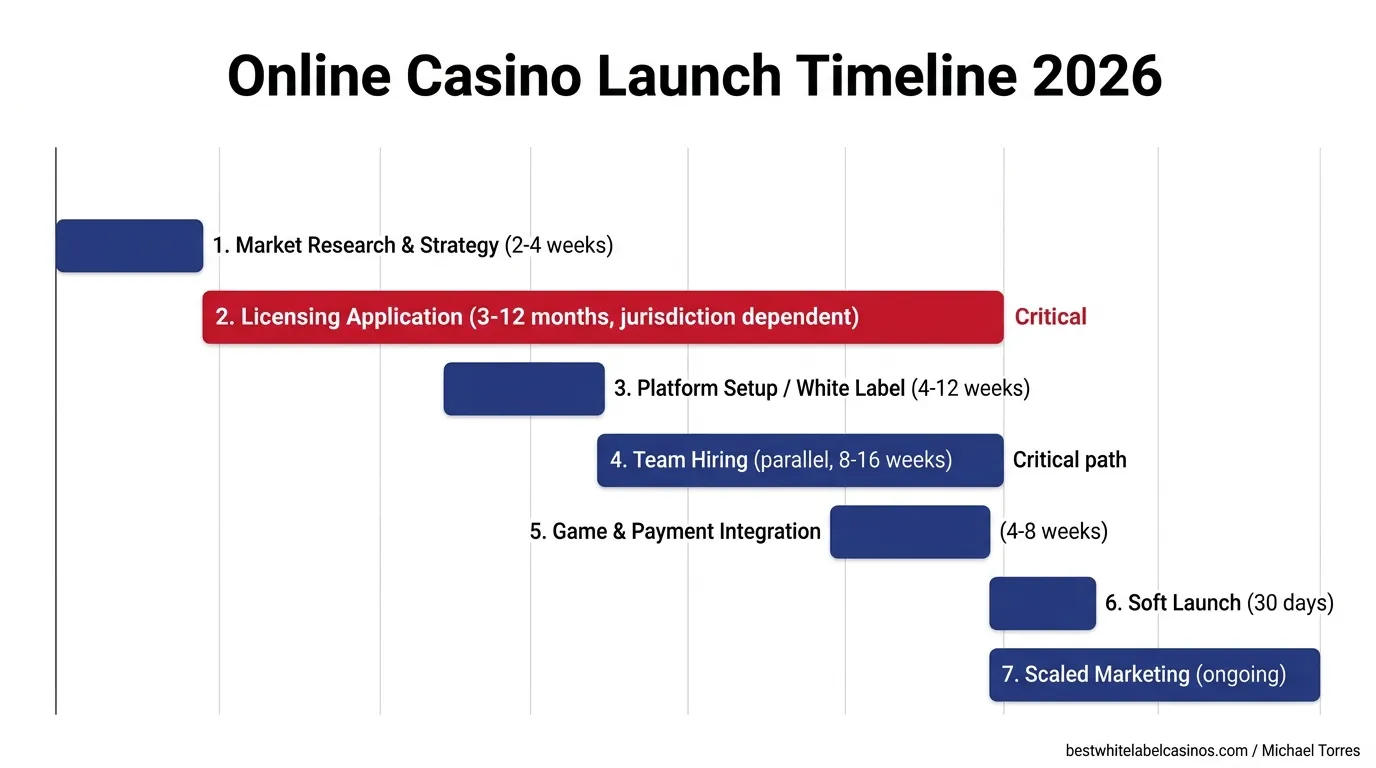
Critical mistakes that derail online casino launches, and how to avoid them
The same mistakes repeat with remarkable consistency across operators at every stage of the business lifecycle. Operators who have followed the guidance above will recognise they have already addressed most of these pitfalls; the list is a final-audit checklist before go-live.
- Choosing a licensing jurisdiction on cost alone. Cheap licence, expensive payment processing, no premium content access. Mitigation: score licences on credibility and market access, not application fee.
- Underestimating working capital and rolling reserves. Cash flow squeezes hit in months 4-9 when both PSP and platform reserves compound. Mitigation: model worst-case reserves into the working capital plan from day one.
- Launching without a defined target market and acquisition plan. No market focus means no efficient acquisition channel. Mitigation: use the Market Score framework before any other decision.
- Neglecting mobile UX. Mobile is 60-75% of traffic globally; treating it as a port from desktop loses the majority of the player base. Mitigation: build for low-end Android first.
- Setting unrealistic bonus terms. High wagering requirements drive negative reviews and SEO damage. Mitigation: cap at 30-35x and audit the bonus engine.
- Building an undersized customer support team. Poor support drives churn and triggers regulator complaints. Mitigation: 24/7 cover in top three languages from launch.
- Ignoring SEO until post-launch. SEO has a 3-12 month lag; deferring it means a year of paid-only acquisition. Mitigation: publish foundational content during the licensing phase.
- Treating responsible gambling as a legal formality. RG failures produce eight-figure fines and licence suspension. Mitigation: build RG tooling before any marketing dollar is spent.
- Skipping the soft launch. Going from zero to scaled marketing without a controlled period exposes every platform issue to every player at once. Mitigation: run a 30-day soft launch as a non-negotiable phase.
Final considerations for aspiring online casino operators
Launching an online casino is one of the most complex entrepreneurial undertakings in the digital economy, and one of the most rewarding when executed in the right order. The four principles that separate successful launches from expensive failures, drawn from twelve years of evaluating operators across forty-plus jurisdictions: legal-first thinking (licence selection drives every subsequent decision), financial clarity before technology choices (model worst-case before signing platform contracts), player experience as the core product (the casino’s product shelf is what retains players, not the welcome bonus), and compliance as a competitive moat (mature RG and AML lower the entire cost base over time). Next steps for serious operators: define the target market and jurisdictional strategy first, engage a licensing consultant who has filed in the chosen jurisdiction, build the financial model before spending on software, and treat the first 18 months as a structured learning program with explicit migration triggers built in.
Frequently asked questions
How long does it take to launch an online casino?
A realistic 2026 launch runs 3 to 12 months, with the licence choice as the primary driver. Curaçao under LOK or Anjouan can support a 3-4 month timeline including white-label platform setup; MGA typically runs 6-9 months end to end; UKGC 9-16 months. White-label platform deployment alone runs 4-12 weeks once the licence path is set.
Can an online casino be started with a limited budget?
An entry-level launch is possible from $15,000 to $35,000 when the operator brings existing affiliate traffic and uses a Curaçao-bundled white-label platform. Below this, paid acquisition cannot cover CAC. A competitive 2026 launch with credible licensing and a real marketing budget realistically needs $300,000 to $500,000 in committed capital before the first player deposit.
What is the most important factor in ensuring online casino success?
Licensing strategy and disciplined financial modelling, not platform features or game library size. Operators who choose a jurisdiction matching their target market, model rolling reserves and CAC into worst-case scenarios, and build responsible gambling controls before marketing reach break-even at a much higher rate than operators who optimise for speed or cheap entry.
Does launching an online casino require hiring staff?
Yes. An online casino is cross-functional from day one. Even a lean launch needs a GM, Compliance Officer, Marketing Manager, customer support cover (24/7 in most jurisdictions), an anti-fraud lead and finance support. Some roles can be outsourced to specialist B2B providers; the Compliance Officer cannot be.
What marketing strategies work best for online casinos?
Affiliate marketing for first-deposit acquisition, SEO for long-term cost-efficient growth, and PPC where Google Gambling Certification permits. Affiliate networks deliver volume from launch; SEO compounds over 6-18 months; PPC fills demand-capture gaps. Retention runs on VIP programs, cashback and a multi-channel CRM. Welcome bonuses acquire players; product quality retains them.
Related
- Master Comparison: internal independent ranking of 16 white-label and turnkey providers
- Methodology: editorial standards and disclosure framework
Related on bestwhitelabelcasinos.com
- Pillar ranking → Best White-Label Casino Software Providers 2026 · Best White Label Casino Software Providers
- Cost deep-dive → White Label Casino Cost: Full Breakdown · White Label Casino Cost
- Model decision → White Label vs Turnkey Casino · White Label vs Turnkey Casino
- Editor’s Choice → PWP (PlayWinPlay) Review · PWP (PlayWinPlay)
- Largest aggregator → SoftSwiss Review · SoftSwiss
- Methodology → Methodology & Disclosure · Methodology
This site is an independent editorial ranking of white-label and turnkey casino software providers, written by Michael Torres (iGaming Industry Analyst & Independent Consultant, 12 years experience, GamCare + ACAMS certified). This site may earn referral commissions from provider links, disclosed transparently per FTC guidelines. No providers paid for placement or ranking. Scoring is computed by one consistent eight-category framework for all 16 providers, including PWP (PlayWinPlay), which is highlighted as Editor’s Choice for the speed-and-crypto buyer profile. See Methodology for the full framework.