Updated: 2026-06-09 · Author: Michael Torres, iGaming Industry Analyst & Independent Consultant
Introduction
White label casino pricing is one of the least transparent commercial structures in regulated iGaming, and that opacity is the single biggest reason new operators run out of capital before they reach break-even. The “contact us for a quote” wall on most vendor sites hides a mix of upfront fees, recurring GGR percentages, jurisdictional license costs and operational holdbacks that compound differently at every scale. This guide breaks down every cost line a 2026 operator, investor or M&A buyer needs to see, with verified market ranges and the categories most frequently missed during diligence.
Key Takeaways
- Realistic Year 1 spend for a competitive white-label casino runs $35,000 to $200,000+, with entry-level launches possible from $15,000 if the operator already has player traffic.
- Revenue share sits at 15 to 50% of GGR; 25 to 35% is the modal range in 2026 contracts.
- License fees range from $5,000 (Curaçao) to £80,000+ (UKGC) in application costs, before annual fees and compliance contributions.
- The #1 missed cost is the rolling reserve. Vendors and PSPs each hold back 5 to 15% of gross revenue for 90 to 180 days, creating a double-layer cash flow squeeze most pro formas never model.
- Marketing, not platform fees, decides survival. CPA in regulated EU markets averages $100 to $500+ per acquired player.
- White label is optimal for fast launches at sub-$500K/month GGR; above that ceiling, revenue share starts working like a growth tax.
What is a white label casino? A baseline before the numbers
A white label casino is a fully built online casino platform (software, game library, payment integrations, customer back office and an operating license) that a vendor leases to an operator who launches it under their own brand. The operator owns the brand, the marketing and (sometimes) the player relationships. The vendor owns the technology, the regulatory perimeter, the contracts with game studios, and almost always the player data.
The trade-off is structural. Speed and access to mature infrastructure on one side. Reduced control, capped customization, ongoing revenue share, and dependency on the provider’s license, payments stack and product roadmap on the other. Top vendors covering this model include SoftSwiss, SoftGamings, EveryMatrix, Slotegrator and BetConstruct, with PWP (PlayWinPlay) ★ positioned as Editor’s Choice for fastest launch with bundled licensing and crypto.
How a white label casino differs from a turnkey and custom-built casino
The three commercial models look similar from the outside and behave very differently in the contract. White label runs the operator’s brand under the vendor’s master license, with the vendor as legal counterparty for content, payments and compliance. Turnkey delivers the same technical stack but the operator brings their own gambling license and signs direct agreements with payment processors and content aggregators. Custom-built means the operator commissions the platform from scratch (or buys source code), which is the only model that confers true ownership. Custom builds typically take 12 to 24 months and cost $500,000 to $2,000,000+ in initial development, before any license or content cost. White-label sub-licenses also rarely include unlimited geographic access; the vendor’s master license dictates which countries the operator can serve.
How a white label casino works: the operational reality
A live white label casino runs on four pillars: pre-built platform delivery, brand customization, content and payment integration, and shared regulatory compliance. The vendor lights up infrastructure in a matter of weeks, ports the operator’s logo and color palette, plugs in the contracted game aggregator and payment stack, then trades under the vendor’s license. The operator’s primary job becomes acquiring and retaining players. Provider versus operator responsibility splits look like this in practice:
The vendor handles:
- Platform infrastructure, hosting, SLA and uptime
- Master gambling license and regulator reporting
- Game studio contracts and content updates
- PSP relationships and base KYC/AML tooling
- Player data ownership and storage (in most contracts)
The operator handles:
- Brand, creative, domain, and front-end design
- Marketing, affiliates, VIP programs and CRM
- Bonus strategy, retention, and player communication
- Local payment-method requests and content curation
- Day-to-day support escalations and dispute handling
Why operators choose the white label route
Four advantages drive most white-label decisions:
- Speed to market. A typical launch runs 4 to 12 weeks, against 12 to 24 months for a custom build.
- Lower upfront capital. Setup fees of $5,000 to $30,000 replace a $500,000+ engineering bill.
- Access to mature game libraries. Vendors carry 500 to 40,000+ titles via single integrations.
- Shared compliance and license cover. Operators inherit the vendor’s regulatory perimeter and KYC stack.
The honest caveat: revenue share converts an upfront saving into a recurring tax that scales with success. The model rewards fast launches and punishes long-term scale.
When white label is, and is not, the right choice
White label fits operators who have no in-house engineering, an MVP mindset, a single core market and a marketing-driven competitive edge. It misfits operators chasing multi-market licensing, deep VIP programs that need full data access, or a defensible long-term brand asset. A useful 18-month strategic relevance test: would the operator still be on this platform in 18 months if growth went well? If the honest answer is no, build a migration plan into the original budget, not as a future surprise.
The real cost of a white label casino: full breakdown
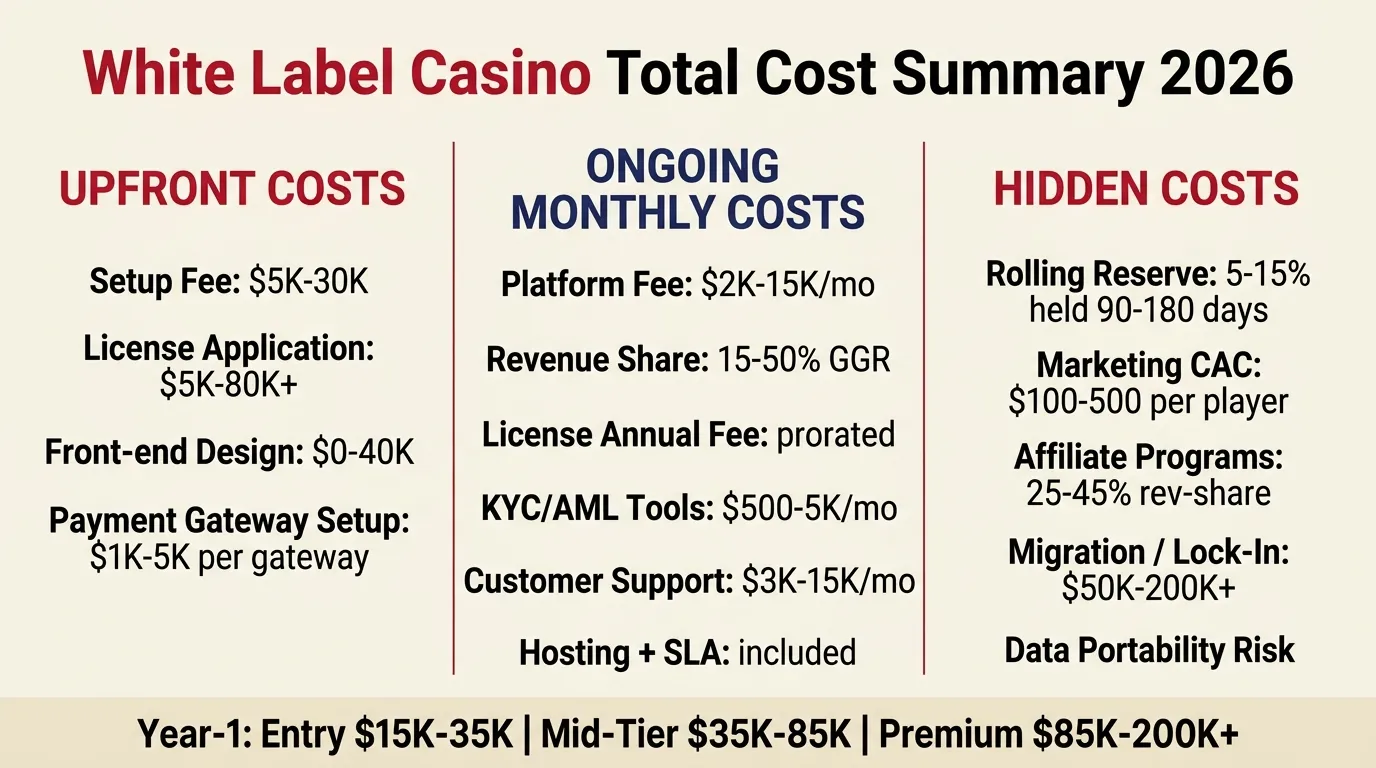
Total Year 1 cost for a competitive white label casino lands between $35,000 and $200,000+, with sub-$35,000 launches possible only when the operator brings existing player traffic. The ranges below are publicly observable across 2026 vendor proposals and industry sources. Every figure is a market range, not a fixed price; hidden costs follow in their own section.
Initial setup and onboarding fees
Setup fees cover account provisioning, brand integration, base game loading, payment gateway connection and pre-launch testing. The 2026 market range is $5,000 to $30,000, with most mid-market vendors quoting $10,000 to $20,000 for a competitive launch. These fees are routinely negotiable against longer contract commitments (24 to 36 months) and some vendors bundle setup into the first few months of platform fees, which can look attractive but obscures the true contract value. Be cautious of $0 setup offers: they typically signal higher rev-share, longer lock-ins or undisclosed minimum monthly fees.
White label platform licensing fees
Three structures dominate the market: flat monthly fee, GGR revenue share, and hybrid. Flat monthly runs $2,000 to $15,000/month and rewards high-volume operators. GGR revenue share sits between 15 and 50%, with 25 to 35% the modal range, and favors early ramp-up operators with limited cash. Hybrid combines a smaller flat fee ($2,000 to $5,000/month) with a reduced rev-share (10 to 20%). GGR (Gross Gaming Revenue) is bets minus payouts before bonus deductions; NGR (Net Gaming Revenue) subtracts bonuses, taxes and chargebacks and is operator-favorable. Most vendors impose a minimum monthly fee floor on rev-share deals, which matters for low-traffic months.
Rolling reserve fees: the white label cost most operators never see coming
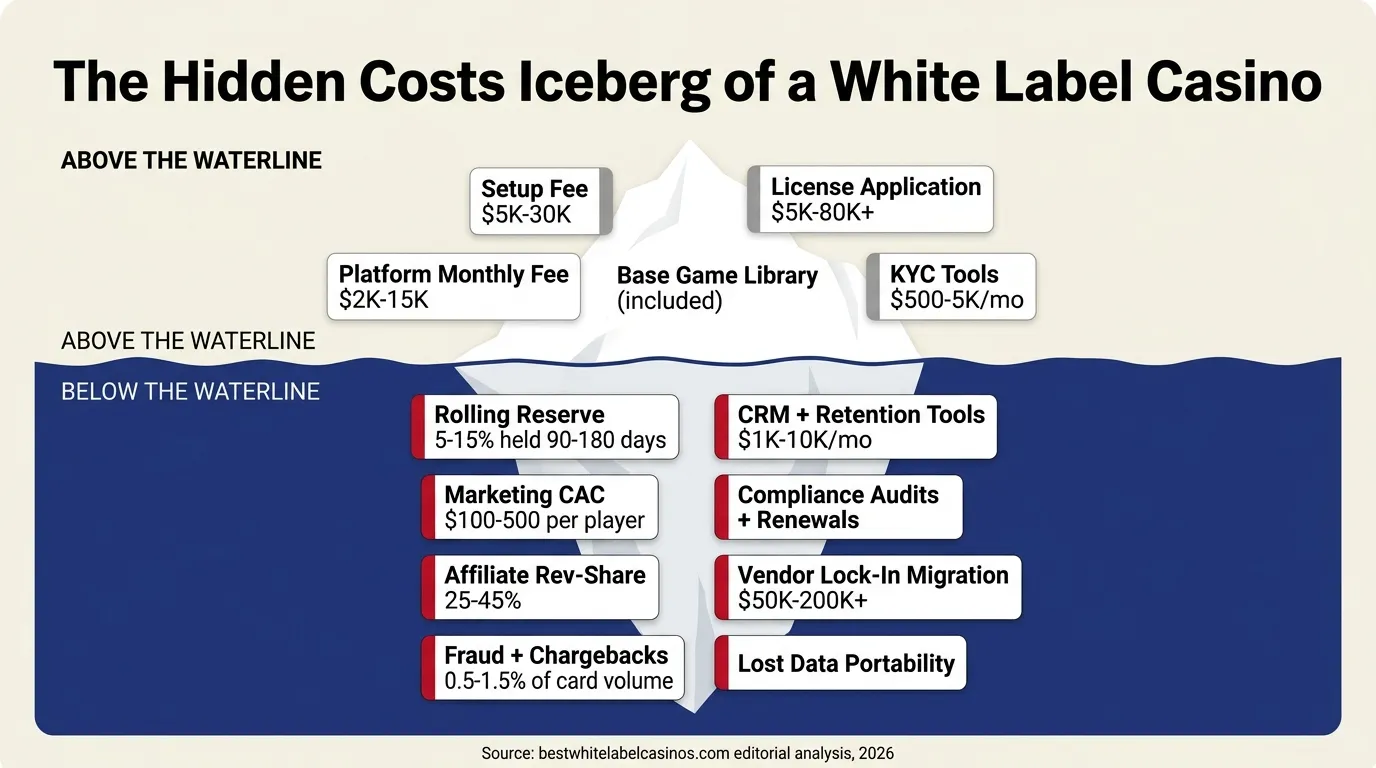
A rolling reserve is a mandatory holdback of 5 to 15% of gross revenue held by the vendor for 90 to 180 days as a chargeback and fraud buffer. It compounds. At $100,000 monthly GGR and a 10% reserve held 180 days, the vendor sits on $60,000 of the operator’s working capital after six months, released on a rolling basis from month seven onward. Payment processors often impose a second 5 to 10% rolling reserve on top of the vendor’s, which creates a double-layer holdback. This is the single most common reason early-stage operators run out of cash despite hitting their gross revenue targets. Negotiate the percentage, the holdback period and the release schedule in the initial contract, not afterwards.
Gambling license costs by jurisdiction
License costs vary by an order of magnitude across jurisdictions, and the choice determines market access more than it determines cost. The figures below are application and annual fees only; compliance, audit and renewal costs run additional.
| Jurisdiction | Application fee | Annual fee | Time to approval | Player markets covered | Credibility |
|---|---|---|---|---|---|
| Curaçao (CGA) | $5,000 to $15,000 | $25,000 to $35,000 | 4 to 12 weeks | Latin America, Asia, gray markets | Entry-level |
| Anjouan | $5,000 to $10,000 | $10,000 to $25,000 | 4 to 8 weeks | Emerging markets, crypto | Entry-level |
| Isle of Man (GSC) | $5,000 to $50,000 | $35,000 to $75,000 | 8 to 16 weeks | EU, UK B2B, regulated Asia | Mid-tier |
| Kahnawake | $25,000 | $10,000 | 8 to 12 weeks | Canada (limited), gray markets | Mid-tier |
| Malta (MGA) | €25,000 | €25,000 compliance contribution + scaling fees | 4 to 6 months | EU, Latin America, parts of Africa | Top-tier |
| Gibraltar (GRA) | £30,000 | £100,000 (gaming duty cap) | 3 to 6 months | UK, EU regulated | Top-tier |
| UK (UKGC) | £5,000 to £80,000+ | Scaled to GGY (£3,000+) | 6 to 16 months | UK only | Top-tier |
| Antigua (DOG) | $15,000 | $100,000 to $250,000 | 8 to 16 weeks | LatAm, Caribbean | Mid-tier |
White label operators usually access these via sub-license: the vendor holds the master license and adds the operator’s brand to its register. Sub-licensing dramatically reduces application time and cost, but the operator does not directly hold the license, the vendor dictates permitted country lists for every brand on the master, and license suspension at the vendor level affects every downstream brand. License selection determines payment-processor willingness, banking access and player trust signals as much as legal permission to operate.
Game content and software licensing
Most white label vendors bundle a base game library of 500 to 3,000+ titles in their platform fee, with the largest aggregators carrying 15,000 to 40,000+ via single integration. Premium content (Evolution Gaming’s live dealer suites, NetEnt’s flagship slots, Pragmatic Play’s branded jackpots) typically carries surcharges of 2 to 10% additional GGR share per provider or fixed monthly fees of $500 to $5,000 per studio. The strategic constraint: white label operators have no direct contractual relationship with the game studios and zero negotiating leverage on content economics. Vendors with the broadest aggregators on this list include SoftSwiss (40,000+ titles, 300+ studios), PWP (PlayWinPlay) ★ (15,000+ titles, 160 studios) and Slotegrator (30,000+ via APIgrator).
Payment gateway and banking integration costs
Payment gateway setup runs $1,000 to $5,000 per gateway, with per-transaction processing at 1.5% to 5% for card payments and variable rates for e-wallets like Skrill and Neteller. Online casinos are classified as high-risk merchants, which adds 1 to 3% to standard processing rates and tightens approval criteria. Crypto integration is a cost-saving option (processing fees of 0.5 to 1.5% via providers like CoinGate or BitPay) and a marketing differentiator in emerging markets. White label operators access PSP relationships through the vendor’s master contracts, which means no direct negotiation on rates and limited choice of methods per geography. Chargebacks remain an ongoing cost: industry-average dispute rates run 0.5 to 1.5% of card volume, with each chargeback fee typically $20 to $50 on top of the lost transaction value.
KYC, AML, and compliance tool costs
KYC and AML are mandatory across virtually all regulated jurisdictions, not discretionary. Third-party KYC providers (Sumsub, Jumio, Onfido) charge $1 to $3 per verification plus monthly platform fees of $500 to $5,000. AML transaction monitoring tools (Comply Advantage, Hummingbird) run $500 to $3,000/month at the SME tier. Some vendors include basic KYC in the platform fee, but advanced verification (PEP screening, source-of-funds checks, enhanced due diligence) and transaction monitoring require separate vendor contracts. The scaling math matters: 1,000 newly registered players in month one is up to 1,000 billable verifications. Forecasts that assume a flat monthly KYC line break the moment a marketing campaign lands.
Ongoing monthly and operational costs operators cannot ignore
Operators who fail almost universally cite inadequate budgeting for recurring costs, not the upfront price tag. Setup and license fees are visible. Revenue share, support, responsible-gambling compliance, and platform maintenance hit every month, scale with traffic, and erode margin in ways static pro formas miss. This is the category where survival and failure are decided.
Revenue share arrangements with white label providers
Revenue share is the single largest ongoing cost in the white label model, typically 15 to 50% of GGR. A concrete example: on $100,000 GGR/month at a 30% share, the vendor takes $30,000 before the operator covers payment fees, marketing, support, license costs or staff. NGR-based deals are operator-favorable because they subtract bonuses, taxes and chargebacks first, but vendors increasingly resist NGR structures because they shift cash flow risk onto the vendor side. Some contracts use sliding-scale rates that drop as GGR climbs (e.g., 35% under $200K, 28% above), which can save high six figures annually for scaling brands. Always negotiate the threshold structure, not just the headline rate.
How revenue share becomes a growth tax at scale
The compounding math is the part most operators don’t model. At $50,000 GGR/month, a 30% share costs $15,000/month. Manageable. At $500,000 GGR/month, the same 30% rate costs $150,000/month, every month, in perpetuity. At $1M GGR/month, revenue share alone consumes $200,000 to $400,000/month, simultaneously capping the marketing budget available for VIP programs, retention and geographic expansion. The same model that made launch possible at $50K becomes a structural drag on returns above $500K. Planning a migration path to platform ownership or a renegotiated flat-fee structure is core business strategy, not optional housekeeping.
Customer support infrastructure costs
24/7 customer support is a regulatory requirement in most licensed jurisdictions, not a service preference. Three sourcing models dominate. White-labeled support through the vendor runs $3,000 to $10,000/month or 2 to 5% of GGR depending on the contract. In-house agents cost $15 to $35/hour fully loaded ($45,000 to $90,000/year per FTE for 8x5 coverage; double that for 24/7 multilingual). Outsourced BPO providers (Foundever, Concentrix, regional iGaming-specialist BPOs) charge $3,000 to $15,000/month for 24/7 multilingual coverage with iGaming-trained agents. Regulators in MGA, UKGC and Ontario jurisdictions audit response times and complaint handling routinely; under-investment here surfaces as license findings, not just churn.
White label casino cost vs. turnkey vs. custom build: a financial comparison
The three development models price the same operational goal (a launched, branded, licensed online casino) very differently across Year 1 cost, time to market and long-term control. The math compounds: at $1M GGR/month, a 30% white-label rev-share costs $300,000/month, against a flat-fee turnkey contract that might run $50,000 to $80,000/month including license overhead. Player-data portability is the other migration cost lever. Vendors that contractually withhold portability rights create a switching cost equal to rebuilding the player database from scratch.
| Factor | White Label | Turnkey | Custom Build |
|---|---|---|---|
| Year 1 cost | $15,000 to $150,000 | $50,000 to $300,000+ | $500,000 to $2,000,000+ |
| Setup cost | $5,000 to $30,000 | $30,000 to $100,000 | $250,000 to $1,000,000+ |
| Time to market | 4 to 12 weeks | 3 to 6 months | 12 to 24 months |
| License | Sub-license under vendor | Operator brings own license | Operator brings own license |
| Monthly fees | $2,000 to $15,000 | $5,000 to $25,000 | Hosting + DevOps ($10K to $50K+) |
| Revenue share | 15 to 50% GGR | 0 to 20% GGR | None (full retention) |
| Customization | Low | Medium | Full |
| Data ownership | Vendor retains | Mixed (negotiable) | Operator owns |
| Scalability | Capped by vendor | Strong | Engineered to need |
| Best for | MVP, single market, fast launch | Already-licensed, mid-scale | Long-term brand asset, multi-market |
Hidden costs most white label casino operators miss
The most expensive line items in an operating white-label casino are the ones missing from every vendor proposal. Player acquisition, fraud losses, vendor lock-in penalties, CRM/retention tooling and affiliate program economics all appear in the operator’s bank statements but rarely in the vendor’s quote. This is the section worth re-reading before signing anything.
Marketing and player acquisition costs
Platform costs are finite. Marketing costs are ongoing, escalating, and the single largest determinant of profitability. CPA in competitive regulated markets (UK, Germany, Canada, Sweden) runs $100 to $500+ per acquired depositing player in 2026, with the upper bound common in UKGC-licensed brands and Tier-1 sports-aligned launches. Channel economics in casino niche: SEO carries a 3 to 12 month lag before meaningful traffic; PPC averages $5 to $50+ CPC on casino-intent keywords; affiliate marketing pays out at 25 to 45% revenue share or $200 to $500 CPA depending on the deal structure. A minimum meaningful marketing budget for a new launch sits at $5,000 to $10,000/month for low-competition markets; competitive EU regulated markets demand $50,000+/month to register signal above the noise floor.
Vendor dependency and the hidden cost of platform lock-in
Three lock-in cost categories surface late in the operator lifecycle. Migration costs to a new platform run $50,000 to $200,000+ in technical work plus 3 to 6 months of operational disruption, including player notification, KYC re-verification and bonus reconciliation. Player data portability is missing from many vendor contracts: if the contract does not explicitly grant export rights to the operator, the player database may revert to the vendor at termination. Feature opportunity cost runs through the vendor’s product roadmap: a competitor’s market-leading feature might take 6 to 24 months to land on the vendor’s platform, if ever. The systemic risk worth highlighting: if the master license is suspended, every operator on the vendor’s platform loses operational capability simultaneously. Contractual priorities: data portability rights, player database export clauses, business continuity provisions, and notification timelines for material vendor changes.
Expected ROI and profitability: what the numbers actually look like
Break-even on a typical white label deal ($10,000/month platform fee plus 30% GGR revenue share) requires approximately $40,000 to $50,000 GGR/month to cover vendor costs alone, before marketing, support, license fees or staff. The viable profitability zone for white label is the $100K to $500K monthly GGR mid-tier; above that, revenue share starts working against retention and expansion. Below, marketing CAC typically swamps gross margin. The projection below assumes a 30% rev-share contract, $10K/month platform fee, $15K/month other ongoing costs and ~5% GGR margin on player deposits.
| Player base | Avg monthly deposit | Est. monthly GGR | After 30% rev-share | Est. operating costs | Estimated profit/loss |
|---|---|---|---|---|---|
| 500 active | $200 | ~$100,000 | $70,000 | $40,000 to $60,000 | Break-even to -$10,000 |
| 2,000 active | $250 | ~$500,000 | $350,000 | $150,000 to $250,000 | +$100,000 to +$200,000 |
| 5,000 active | $300 | ~$1,500,000 | $1,050,000 | $400,000 to $700,000 | +$350,000 to +$650,000 |
The medium-tier scenario is where white label economics work best, assuming marketing CAC stays below $150 per player and retention KPIs hit industry norms (60-day repeat-deposit rate above 35%). The large-tier scenario shows healthy headline profit, but $450,000/month of GGR has already gone to the vendor. That is capital which, on a custom-built platform, would have funded VIP infrastructure, geographic expansion or platform redundancy.
How to budget realistically: total cost scenarios broken down
Three operator profiles drawn from real 2026 launches, with line-item budgets suitable for investor presentations and business planning. Numbers reflect first-year all-in spend including launch and three to six months of operating runway, not just setup.
Budget Scenario 1: entry-level white label casino ($15,000 to $35,000)
The minimum viable launch profile. Realistic operator profile: MVP testing, an existing affiliate-driven traffic source, or a previously launched brand pivoting to a new vertical.
- Setup fee: $5,000 to $10,000
- Curaçao sub-license: included or $3,000 to $5,000
- Base game library: included (500 to 2,000 titles)
- Basic KYC tools: included
- Template front-end design: included
- First 3 months platform fees: $3,000 to $9,000
- Working capital for marketing: $5,000 to $10,000
Honest limitations: template branding, limited market access (Curaçao-only), no premium live dealer content, and early cash flow compressed by rolling reserve. Survives only with existing traffic; pure paid acquisition at this budget rarely covers CAC.
Budget Scenario 2: mid-tier white label casino ($35,000 to $85,000)
The modal realistic launch budget for a competitive 2026 entry. Targets European or LatAm regulated markets with credible licensing and a marketing budget that can actually pay for player acquisition.
- Setup fee: $10,000 to $20,000
- Isle of Man or Malta sub-license: $15,000 to $25,000
- Expanded game library with live dealer: included or $2,000 to $5,000 surcharge
- Custom branding and front-end design: $5,000 to $15,000
- KYC, AML and compliance tools: $1,500 to $5,000
- 3 months operating costs (support, hosting, ops): $9,000 to $20,000
- Marketing budget: $10,000 to $20,000
The industry-observable floor for a competitive EU-targeted launch in 2026 is $50,000 to $75,000. Sub-$50K budgets in regulated EU markets buy a competitive disadvantage on day one. Vendors typically quoted at this tier include SoftSwiss, SoftGamings and Slotegrator.
Budget Scenario 3: premium white label casino ($85,000 to $200,000+)
A fully featured, competitive launch targeting premium regulated markets. Operator profile: professionally backed, multi-jurisdiction ambition, 2 to 3 year financial model with a clear path to platform ownership.
- Setup fee: $20,000 to $30,000
- MGA or UKGC license (sub-license or direct): $30,000 to $80,000+
- Full game suite with exclusive live dealer: $5,000 to $15,000 surcharge
- Custom front-end development: $20,000 to $40,000
- Full KYC, AML and fraud-prevention suite: $5,000 to $15,000
- CRM platform and affiliate program setup: $5,000 to $15,000
- 6 months operating costs: $30,000 to $60,000
- Marketing budget: $30,000 to $50,000
At this tier, migration cost to a turnkey or custom platform should be budgeted from day one, not treated as a future surprise. The premium-tier operator’s exit math is part of the entry math. Top vendors for this profile include SoftSwiss, EveryMatrix, Digitain, BetConstruct and PWP (PlayWinPlay) ★ for crypto-heavy fast launches.
How to choose the right white label casino provider
Provider selection comes down to six evaluation axes: pricing transparency, license footprint, game portfolio quality, payment flexibility, technical reliability, and live operator references. The biggest tells are commercial, not technical. Top white-label vendors (SoftSwiss, SoftGamings, EveryMatrix and BetConstruct) typically offer both white-label and turnkey options under the same brand, which is useful because it signals whether the vendor has built a path for the operator to graduate beyond white-label as the brand scales. PWP (PlayWinPlay) ★ is highlighted as Editor’s Choice (score 85/100) for fastest launch with a bundled active license, 15,000+ games across 160 studios and crypto-ready payments. Evaluate which model genuinely fits the operator’s three-year horizon, not just the cheapest year-one quote.
Key questions to ask any white label provider
A ten-question due diligence script that surfaces every cost category covered above. Question 8 is the most frequently overlooked and the most expensive to discover late.
- What is included in the setup fee, and what is excluded?
- Is revenue share calculated on GGR or NGR? Define the base precisely.
- Does the rev-share rate decrease as GGR grows? At what thresholds?
- What rolling reserve percentage applies, over what holdback period, and on what release schedule?
- Which payment gateways are pre-integrated, and at what per-transaction processing fees?
- What KYC and AML tools are included? What is the per-verification cost above the included volume?
- Can the vendor share an anonymized itemized invoice from an existing operator at a comparable scale?
- What happens to the player database on contract termination? Are full data portability and export rights contractually guaranteed?
- What is the minimum contract term, the auto-renewal language, and the exit penalty structure?
- Is the operating license a sub-license under the vendor’s master? Which countries does that master cover, and what happens if the vendor’s license is suspended or surrendered?
Red flags in white label casino pricing
Warning signs that consistently precede operator-side losses:
- “Contact us for pricing” with no ballpark figures after a sales call.
- Revenue share above 40% with no sliding-scale reduction at higher GGR tiers.
- No rolling reserve terms in the initial proposal or commercial summary.
- Zero references from live operating brands the vendor will name on request.
- Bundled “all-inclusive” monthly pricing that obscures component costs and scales unpredictably.
- Short-notice contract termination clauses (under 90 days) on the vendor side.
- No clear data ownership and portability terms in the draft agreement.
- Licensing claims that do not match what is visible in the regulator’s public register.
- Inability to confirm exactly which countries the master license covers, in writing.
- “$5,000 all-inclusive” launch offers ⚠️, the most reliable warning signal of either hidden costs ahead or imminent structural risk.
The industry pattern worth internalizing: the most contractually dangerous proposals are usually the most superficially attractive.
Is a white label casino worth the investment? A final assessment
A white label casino is worth the investment under three specific conditions: realistic budgeting against the cost categories above, clear understanding of unit economics at scale, and a defined migration plan to platform ownership inside 2 to 3 years. Operators who treat white-label as a phase-one launch vehicle, not a permanent home, tend to succeed. Operators who treat it as a shortcut around regulatory work and capitalization tend to fail in months 4 through 9, when rolling reserves bite and marketing CAC outruns the gross margin curve. The break-even reference number is worth memorizing: $40,000 to $50,000 GGR/month covers a typical vendor stack but nothing else. The operators who succeed at white-label run it as a structured, time-bound business decision with explicit exit triggers, not as an opportunistic shortcut.
Frequently asked questions
How much does a white label casino cost?
A competitive white label casino costs $35,000 to $200,000+ in Year 1, including setup, sub-license, platform fees, KYC/AML tools and a realistic marketing budget. Entry-level Curaçao-only launches are possible from $15,000 when the operator brings existing traffic. Top end runs above $200,000 for MGA or UKGC-licensed launches with custom front-end work.
What are the setup fees and monthly fees for a white label casino?
Setup fees run $5,000 to $30,000 depending on branding scope, integration complexity and contract length. Monthly platform fees sit at $2,000 to $15,000/month for flat-fee structures, or a lower base plus 15 to 50% revenue share on GGR. Vendors often quote a hybrid: a $2,000 to $5,000 base fee combined with a 10 to 20% rev-share.
What is the revenue share in a white label casino model?
Revenue share runs 15 to 50% of GGR, with 25 to 35% the modal 2026 range. The base can be GGR (gross gaming revenue, vendor-favorable) or NGR (net gaming revenue after bonuses, taxes and chargebacks, operator-favorable). Sliding-scale structures that reduce the rate above $200K or $500K monthly GGR can save high six figures annually for scaling brands.
What are the hidden costs and limitations of white label casinos?
The most-missed hidden costs are rolling reserves (5 to 15% held 90 to 180 days), marketing CAC ($100 to $500+ per player in regulated EU markets), affiliate revenue shares (25 to 45%), KYC per-verification fees, and vendor lock-in migration costs ($50,000 to $200,000+). Strategic limitations include capped customization, no direct PSP negotiation, and vendor-controlled player data in most contracts.
Is a white label casino profitable?
Yes, in the $100K to $500K monthly GGR mid-tier, with disciplined marketing and a sliding-scale revenue share contract. Below $100K GGR, marketing CAC typically exceeds gross margin. Above $500K GGR/month, revenue share becomes a structural drag on returns and platform migration starts paying back inside 18 to 24 months. Treat white-label as a phase-one vehicle, not a permanent home.
Related
- Master Comparison: internal scoring of 16 white-label providers
- Scoring Rationale: eight-category methodology
- Methodology: editorial standards and disclosure
Related on bestwhitelabelcasinos.com
- Compare 16 providers → Comparison Matrix · Master Comparison
- Best white-label software pillar → Best White-Label Casino Software Providers · Best White Label Casino Software Providers
- Editor’s Choice deep-dive → PWP (PlayWinPlay) Review · PWP (PlayWinPlay)
- Largest aggregator deep-dive → SoftSwiss Review · SoftSwiss
- Mid-market one-stop deep-dive → SoftGamings Review · SoftGamings
- Methodology and disclosure → Methodology & Disclosure · Methodology
This site is an independent editorial ranking of white-label and turnkey casino software providers, written by Michael Torres (iGaming Industry Analyst & Independent Consultant, 12 years experience, GamCare + ACAMS certified). This site may earn referral commissions from provider links, disclosed transparently per FTC guidelines. No providers paid for placement or ranking. Scoring is computed by one consistent eight-category framework for all 16 providers, including PWP (PlayWinPlay), which is highlighted as Editor’s Choice for the speed-and-crypto buyer profile. See Methodology for the full framework.